All articles
Invisalign & OrthoJune 16, 20265 min read

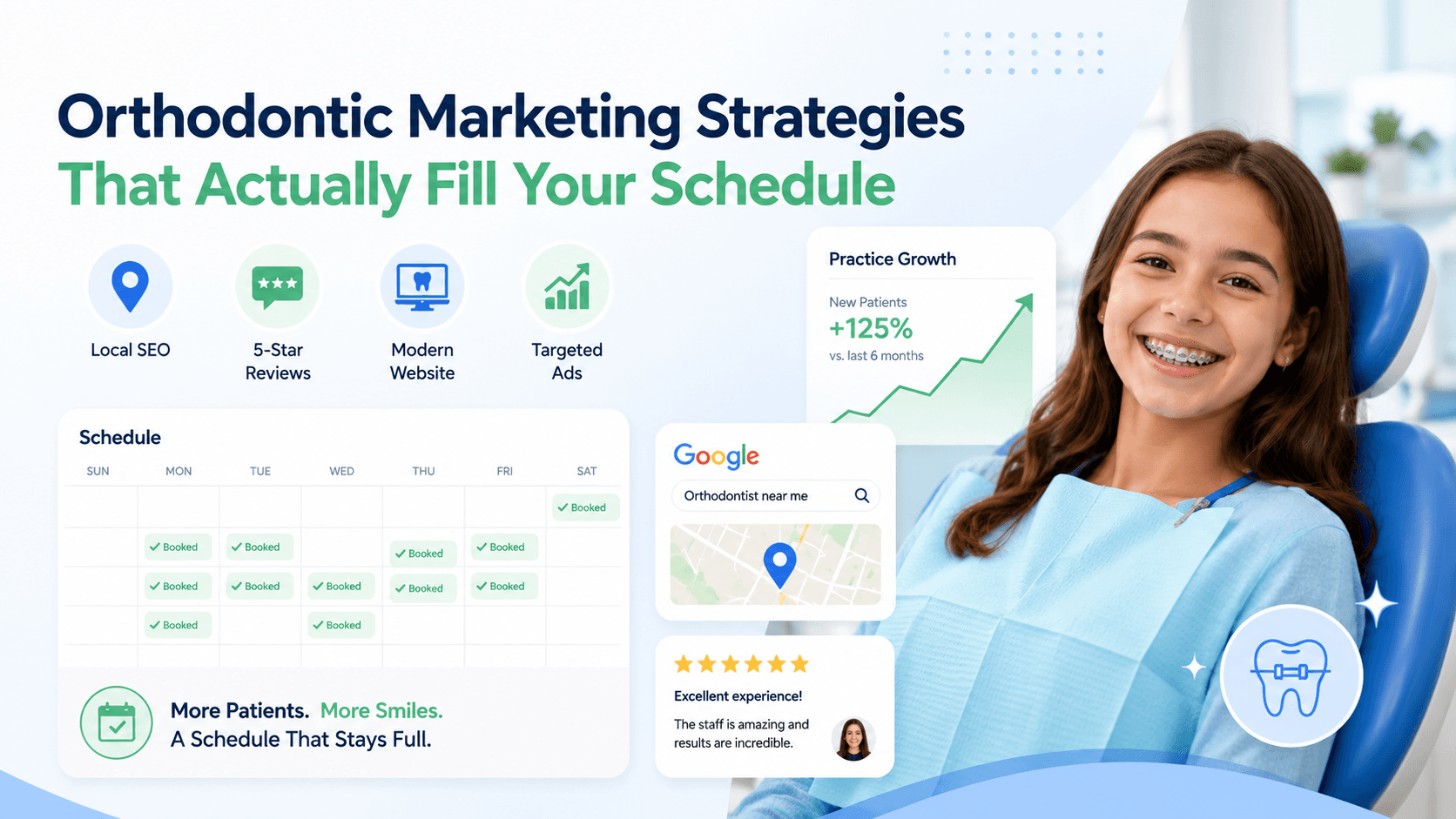
Orthodontic Marketing Strategies That Actually Fill Your Schedule

Practical orthodontic marketing strategies to grow your patient base, improve local visibility, and convert more consultations into starts.

Orthodontic Marketing Strategies

Most orthodontic practices are doing half of their marketing well. They run ads, post on social media, maybe even rank on Google. But they have no system for turning that visibility into booked consultations or treatment starts.

The result is inconsistent case flow, unpredictable revenue, and a practice that constantly chases new patients instead of consistently attracting them.

This guide covers the specific strategies that move the needle for orthodontic practices: local search visibility, consultation conversion, trust-building content, and the gaps most clinics overlook.

Why Orthodontic Marketing Is Different From General Dental Marketing

Orthodontic treatment is a considered purchase. A patient does not decide to start Invisalign or braces the same way they book a cleaning. The decision cycle is longer, often involves multiple household members, and requires a higher level of trust before any commitment is made.

General dental marketing tactics do not solve this. A strong Google Business Profile alone will not close a $5,000 case. A single ad will not replace a structured follow-up process.

Orthodontic marketing needs to work across three stages:

  1. Visibility: Getting found by people actively searching for orthodontic treatment in your area

  2. Trust: Giving prospects enough information and proof to feel confident choosing your practice

  3. Conversion: Moving interested prospects into booked consultations, then into treatment starts

Most practices invest heavily in stage one and almost nothing in stages two and three.

According to Pew Research, 77% of patients search online before booking a healthcare appointment. For orthodontic practices, that means your digital presence is doing the first impression work long before anyone picks up the phone.

The Local Search Foundation Every Orthodontic Practice Needs

How Does Google Business Profile Optimization Work for Orthodontists?

Your Google Business Profile is often the first thing a prospective patient sees before they ever reach your website. An incomplete or poorly optimized profile loses cases before the conversation even starts.

Key elements to get right:

  • Set your primary category to "Orthodontist," not a general dental category

  • List every treatment you offer: braces, Invisalign, clear aligners, retainers, teen orthodontics, adult orthodontics

  • Add photos of your team, office, treatment rooms, and before-and-after cases (with patient consent)

  • Pre-populate your Q&A section with questions patients actually ask

  • Build review volume consistently; recency and volume both influence local ranking

One underused tactic: post consistently to your Google Business Profile using treatment-specific updates, patient milestones, or consultation offers. Most orthodontic practices leave this section completely empty.

Local SEO for Orthodontic Practices

Local SEO for orthodontics means ranking for searches like "orthodontist near me," "Invisalign provider in [city]," and "braces cost [city]." These are high-intent searches from people already in the decision process.

The pages that tend to rank for these terms share a few characteristics:

  • They are geographically specific, mentioning the city or neighborhood in headings and body copy

  • They answer the questions patients ask before booking: cost, process, duration, and financing options

  • They include trust signals: credentials, years in practice, cases completed, and technology used

  • They are linked to from relevant local and dental sources

A single generic "orthodontic services" page will not compete against practices that have built location-specific, question-answering content.

The Angles Most Orthodontic Practices Are Not Using

Adult Orthodontics as a Separate Market

Most orthodontic marketing is implicitly aimed at teens and parents. This leaves a significant segment underserved: adults who want straighter teeth but do not see themselves in traditional orthodontic messaging.

Adults have different concerns than teens:

  • Discretion: They want to know treatment will not be obvious at work

  • Timeline: They want the shortest effective duration

  • Fit with their life: Flexible appointments, payment options, and a practice environment that does not feel designed for teenagers

A dedicated landing page, targeted content, and specific ad messaging for adult orthodontics is one of the fastest ways to open a new patient segment without changing your services at all.

The Financing Conversation as a Marketing Asset

Orthodontic treatment cost is one of the top reasons prospects do not convert. Most practices bury their financing information or only mention it during the consultation.

Putting financing information front and center in your marketing lowers the barrier to booking significantly. Patients who know monthly payment options exist before the consultation are far more likely to show up and commit.

A dedicated financing page that answers specific questions ("Can I get braces with no credit check?" or "What does Invisalign cost per month?") serves both as SEO content and as a conversion tool. According to the American Association of Orthodontists, cost and payment flexibility are consistently among the top concerns patients raise before starting treatment.


Before-and-After Content Done Strategically

Before-and-after photos are standard in orthodontics, but most practices use them ineffectively. Posting generic smile transformations without context does not build trust or drive bookings.

Patient Acquisition Playbook cover
Free Ebook — 2026 Edition

The Dental Practice Patient Acquisition Playbook

Proven strategies to fill your chair and grow revenue. Free download.

Download

Strategic use of case content looks like this:

  • Show cases that match your target patient profile: adult professionals, teens with complex cases, patients who had previously avoided treatment

  • Add brief context: treatment duration, the patient's main concern, and the approach used

  • Use these consistently across your website, Google Business Profile, and social channels

This turns case documentation into a patient acquisition asset rather than a passive gallery.

Consultation Conversion: Where Orthodontic Revenue Is Won or Lost

What Happens After the Consultation?

Many orthodontic practices have a leaky consultation process. A prospective patient books a free consultation, attends the appointment, and leaves without committing. No structured follow-up, no clear next step offered, no system for re-engaging if they go quiet.

The gap between a prospect's first inquiry and their treatment start can be weeks or months. During that window, they are comparing practices, reading reviews, and sometimes simply forgetting to follow up.

A structured follow-up sequence, through email, SMS, or both, keeps your practice top of mind and addresses the remaining questions preventing commitment. Even a basic three-touch follow-up sequence consistently improves consultation-to-start conversion rates.

What Does a High-Converting Orthodontic Website Look Like?

A website that converts orthodontic patients is not a digital brochure. It answers the questions that matter at every stage of the decision process.

High-converting orthodontic websites typically include:

  • A homepage that communicates who you treat, what makes your practice different, and how to book

  • Treatment-specific pages for each service with cost ranges, process explanations, and financing information

  • A current, prominent reviews section

  • A frictionless booking experience: online scheduling, a clear consultation offer, or a visible call to action

Slow load times, unclear calls to action, and outdated design all reduce conversion. A prospective patient who cannot quickly find what they need will leave and contact the next practice in their search results.

Measuring What Actually Matters

Impressions, follower counts, and website traffic do not tell you whether your marketing is working. The metrics that matter for an orthodontic practice are:

New consultation bookings per month: Direct measure of marketing effectiveness

Consultation-to-start conversion rate: Reveals how well your process converts interest

Cost per consultation (paid ads): Shows ad efficiency and targeting quality

Local search rankings for key terms: Measures organic visibility for high-intent searches

Review volume and average rating: Influences trust and local search ranking

Tracking these consistently shows you where growth is happening and where gaps need attention.

Where to Start

If you are not sure where to focus first, audit three things:

  1. Your Google Business Profile: Is it fully optimized, regularly updated, and generating reviews?

  2. Your website: Does it answer a new patient's questions before they call, and does it make booking easy?

  3. Your follow-up process: What happens after a prospect inquires or attends a consultation?

These three areas account for most of the gap between practices that grow steadily and those that plateau.

If you want to identify exactly where your orthodontic marketing is losing ground, North Media works with orthodontic and dental practices to build the systems that connect visibility, trust, and conversion into consistent patient growth.

Frequently Asked Questions About Orthodontic Marketing

How much should an orthodontic practice spend on marketing?

Most orthodontic practices allocate between 4% and 8% of gross revenue toward marketing. The right number depends on growth goals, current patient volume, and local competition.

Do orthodontic practices need paid ads if they already rank well organically?

Organic SEO builds long-term visibility. Paid ads let you target specific treatments, locations, or audience segments immediately and scale based on capacity. Both serve different purposes and work best together.

How long does it take to see results from orthodontic SEO?

Most practices see measurable ranking improvements within three to six months of consistent SEO work. Competitive markets may take longer. Paid ads and Google Business Profile optimization can deliver results faster.

What social media platforms work best for orthodontic practices?

Instagram and Facebook remain the strongest platforms for before-and-after content and community engagement. TikTok is growing for reaching teen audiences and their parents. Platform choice should follow where your target patients spend time.

How do online reviews affect orthodontic patient acquisition?

Reviews directly influence local search rankings and patient decision-making. Practices with higher review volume and stronger average ratings consistently outperform competitors in local search and earn more trust before the first contact is made.

Free, no-pressure strategy call

Want results like the practices we write about?

Book a free strategy call and we'll show you exactly how to turn search demand into booked new patients.

Book a Strategy Call

Short on time? Chat with a dental marketing expert, no booking required.