

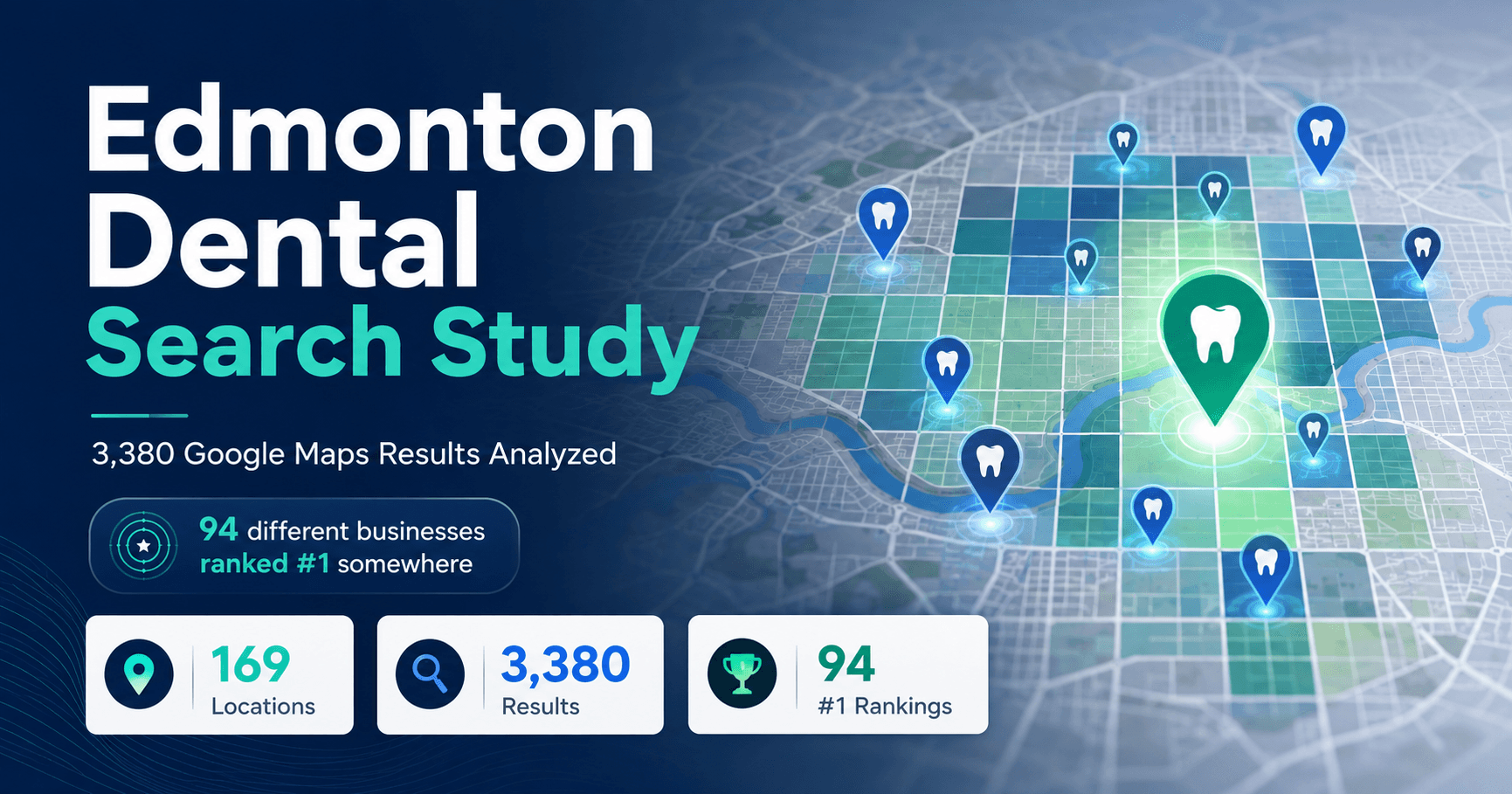
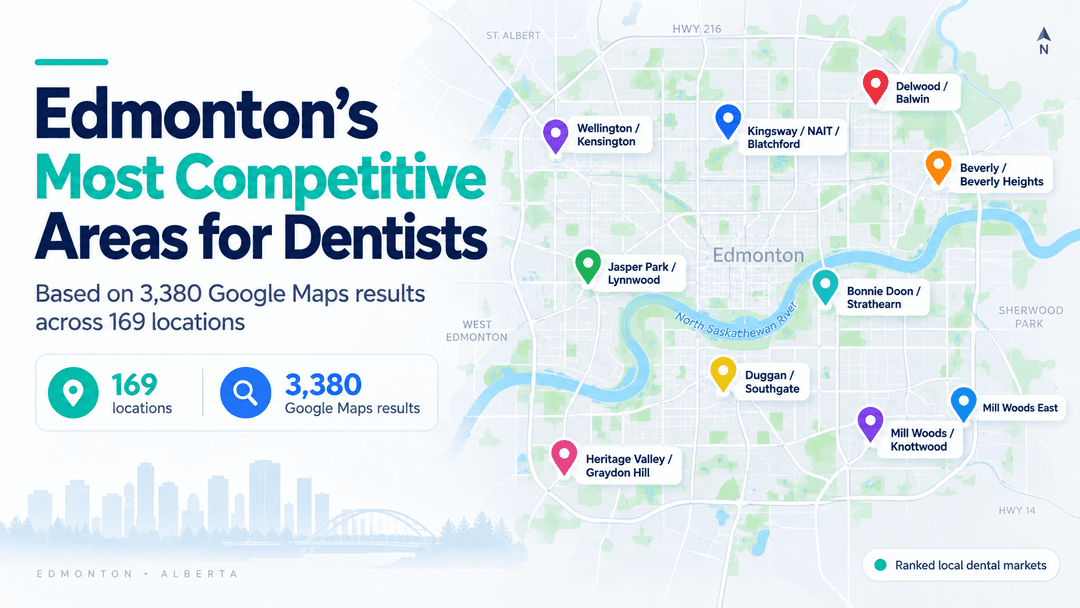
North Media analyzed Google Maps results for the search term “dentist” from 169 locations across Edmonton and the surrounding area.
We captured the top 20 results at every location.
That gave us:
3,380 Google Maps results
524 unique Google Business Profiles
382 businesses with Edmonton addresses
94 different businesses that ranked #1 somewhere
A median #1 result only 1.5 km from the person searching
The takeaway?
Your dental practice does not have one Google ranking.
It has a local visibility footprint.
You might rank #2 when you search from inside your clinic.
A patient three or four kilometres away may see something completely different.
And that means the question dentists should be asking isn't:
“Where do we rank on Google?”
It's:
“How much of our actual patient market can see us?”
Quick heads-up: This is a detailed study and will take about 5–10 minutes to read. But if you own or manage a dental practice in Edmonton, it’ll be worth your time.
The Edmonton Dental Search Study at a Glance
Metric | Result |
|---|---|
Search term analyzed | dentist |
Search locations | 169 |
GeoGrid | 13 × 13 |
Results captured at each location | 20 |
Total Google Maps observations | 3,380 |
Unique Google Business Profiles | 524 |
Edmonton-address businesses | 382 |
Different businesses ranking #1 somewhere | 94 |
Approximate spacing between grid points | 2 miles |
Study date | August 21, 2026 |
Why should a dentist care?
Because most ranking reports answer the wrong question.
They tell you:
Position #3
But they often don't tell you:
Position #3 from where?
Google says local search results are primarily influenced by relevance, distance and prominence.
So when the person searching moves, the results can move too.
Here's What This Looks Like in the Real World
Imagine your practice is in southwest Edmonton.
You search:
dentist
from inside your clinic.
You rank:
#2
Excellent.
Now a potential patient searches from home several kilometres away.
You might be:
#8
Someone slightly farther away searches.
You might be:
#16
And in another neighbourhood, you may not appear in the top 20 results at all.
All of those rankings can be accurate.
At the same time.
That's why checking your ranking from one computer or one phone tells you only a small part of the story.
The Biggest Finding: 94 Different Businesses Ranked #1
Across the full 169-location study:
94 different businesses held the #1 Google Maps position at least once.
That's a remarkable amount of variation for one keyword in one metropolitan market.
Because some search points on the edge of the grid extended toward surrounding municipalities, we also ran a more conservative analysis.
We isolated 63 search locations where every one of the top 20 results had an Edmonton address.
Even there:
56 different Edmonton businesses ranked #1 somewhere.
So there is no single, universal:
“#1 dentist in Edmonton”
Google's local results change based partly on where the person searching is located.
For dentists, Edmonton isn't really one Google Maps market.
It's a collection of overlapping micro-markets.
Distance Matters — A Lot
One of the strongest patterns in the study was the relationship between ranking position and distance.
For Edmonton-address businesses, we calculated the straight-line distance between each dental business and the location where the search occurred.
Here is what we found:
Google Maps Position | Median Distance From Searcher |
#1 | 1.5 km |
#2–#3 | 2.5 km |
#4–#10 | 3.9 km |
#11–#20 | 5.2 km |
The median #1 result was only 1.5 kilometres away from the searcher.
Businesses appearing between positions #11 and #20 were a median of about 5.2 kilometres away.
That doesn't mean 5.2 km is some kind of Google limit.
It isn't.
Businesses in the dataset appeared from farther away.
What the data does show is:
Stronger-ranking businesses were generally closer to the person searching.
That aligns with Google's own explanation of local search, where distance is one of the primary ranking factors.
Think of Distance Like Gravity
Every dental practice has to deal with proximity.
You can't SEO your clinic into physically moving closer to the person searching.
If someone is standing 500 metres from your practice, location is working heavily in your favour.
As that person moves farther away, staying highly visible generally becomes harder.
But distance is not the only factor.
Google identifies three primary local ranking considerations:
Relevance
How well your business matches what the person is looking for.
Distance
How far the business is from the searcher.
Prominence
How well known or established Google believes the business to be.
This is why some practices can continue appearing farther away than others.
They can't remove distance.
But they may have enough relevance and prominence to stay competitive despite it.
Most Edmonton Dental Businesses Had a Small Visibility Footprint
This may be the most useful finding for practice owners.
Of the 382 Edmonton-address businesses that appeared somewhere in our study, the median business appeared at only:
3 of 169 search locations.
Approximately:
34% appeared at only one location
56% appeared at three locations or fewer
18% appeared at 10 or more locations
Just over 6% appeared at 20 or more locations
In other words:
Appearing on Google is not the same as having broad Google visibility.
A dental practice can rank extremely well close to the office but have a surprisingly small geographic footprint.
Think of Google Maps Visibility Like Wi-Fi
Standing beside your Wi-Fi router, your signal probably looks excellent.
Walk upstairs.
The signal weakens.
Go into the backyard.
It weakens again.
You wouldn't judge the quality of your entire Wi-Fi network while standing beside the router.
You would look at coverage.
Local search works in a similar way.
A dentist should not only ask:
“Do we rank?”
The more useful question is:
“Where do we rank strongly?”
The geographic area where your practice maintains useful visibility is what we call your:
Local Visibility Footprint
Some Edmonton Dental Practices Travel Much Farther Than Others
A smaller group of dental businesses appeared across a much broader portion of the grid.
Examples of Edmonton-address businesses with substantial top-20 visibility included:
Practice | Locations Where It Appeared in the Top 20 |
Orchards Dental | 38 |
Albany Dental Edmonton | 29 |
Reliance Dental Family Dentistry | 28 |
Meraki Dental | 28 |
Newbury Dental | 27 |
Harvest Pointe Dental | 27 |
Jagare Ridge Dental South Edmonton | 27 |
Edmonton West Dental Clinic | 26 |
Keswick Dental | 25 |
Landmark Dental South Edmonton | 25 |
This does not mean these are the “best dentists in Edmonton.”
It also does not mean these practices ranked #1 everywhere.
This study measured:
one keyword
across:
one geographic snapshot
on:
one date.
What we can say is:
These businesses maintained top-20 visibility for “dentist” across a relatively large number of search locations in this dataset.
That is a measure of geographic reach.
But reach isn't everything.
Reach and Dominance Are Not the Same Thing
Consider two dental practices.
Practice A
Appears across 35 locations.
But usually ranks between #7 and #14.
Practice B
Appears across only 15 locations.
But frequently ranks #1, #2 or #3.
Which has better local SEO?
They're strong in different ways.
Practice A has:
Geographic Reach
Practice B has:
Local Dominance
The strongest local search presence may combine both:
broad coverage + strong rankings
This is also why one “average ranking” can be misleading.
Two practices could both have an average position of 7.
But one might appear across 40 locations while the other appears across only eight.
That is not the same level of Google Maps visibility.
A 4.9-Star Rating Is Great. It Is Also Very Common.
Google reviews matter.
Patients use reviews when choosing a dentist, and Google itself says review count and positive ratings can contribute to local ranking.
But there is an important nuance in this study.
Our export included Google star ratings.
It did not include total review counts.
So we can analyze whether star ratings differed across ranking groups.
We cannot responsibly say whether:
800 reviews beats 150 reviews
based on this dataset alone.
Among Edmonton-address businesses:
Median Google rating: 4.8
Approximately 70% had ratings of 4.8 or above
Roughly half had ratings of 4.9 or above
Average ratings by ranking position were:
Position | Average Google Rating |
#1 | 4.85 |
#2–#3 | 4.83 |
#4–#10 | 4.81 |
#11–#20 | 4.82 |
There's very little separation.
That does not mean reviews don't matter.
What it suggests is more specific:
Star rating alone did not explain the major differences in visibility we saw across Edmonton.
That's also understandable.
When nearly everyone has:
4.8
4.9
4.9
5.0
4.8
4.9
simply having a 4.9 isn't particularly unusual anymore.
The more useful questions may be:
How many reviews do you have?
How recently are patients reviewing you?
How quickly are competitors adding reviews?